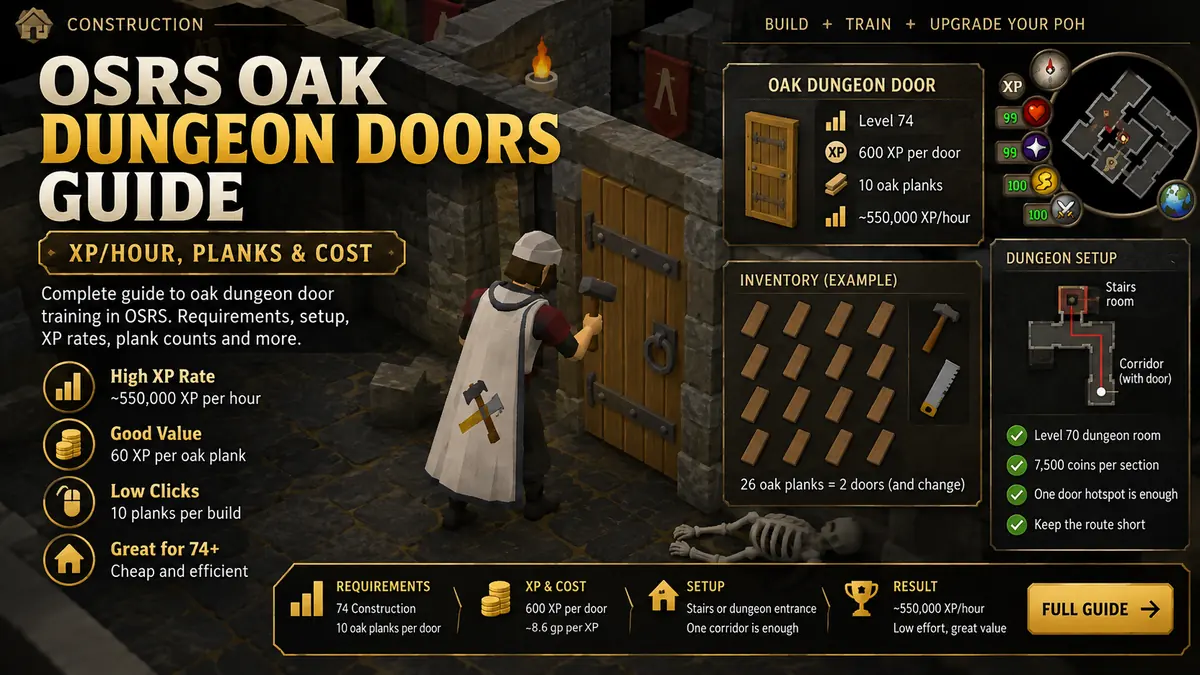
An oak dungeon door requires 74 Construction, consumes 10 oak planks and gives 600 Construction experience, which is 60 experience per oak plank. It reaches around 550,000 experience per hour at maximum efficiency, which is close to a teak garden bench at roughly two thirds of the cost.
The reason it has a following is not the rate. It is that ten planks per build means fewer builds per hour than any other fast method, so the same experience arrives with far less clicking.
Oak dungeon door requirements
| Requirement | Detail |
|---|---|
| Construction level | 74 for the door |
| Room | Dungeon, level 70, 7,500 coins per section |
| Access | Staircase in a skill hall or quest hall, or a dungeon entrance in a garden |
| Hotspot | Door space |
| Materials | 10 oak planks per door |
| Experience | 600 per door |
| Build time | 5 game ticks, 3 seconds |
| Tools | Hammer and saw |
| Membership | Required |
A crystal saw covers the door from base 71, but the dungeon room at level 70 is not saw-boostable, so a base 71 account with a saw can build the door but needs a visible boost for the room. In practice 74 arrives before that matters.
The dungeon setup
This is the part that is genuinely different from every other Construction method, because the room does not exist until you make a way down to it.
Getting into a basement. You need either a staircase built in a skill hall or a quest hall, or a dungeon entrance built in a garden or formal garden directly above where the dungeon will sit.
The rooms. Every dungeon section costs 7,500 coins and level 70 Construction. A corridor is a straight passage. A junction is two crossing corridors. Both carry door space hotspots, and both count against your total room limit.
What to build. One stairs room and one corridor is enough. The whole method runs off a single door hotspot, so extra rooms are extra walking.
Keep the route from your house portal to the hotspot as short as it can be. Every step is repeated thousands of times, and no servant upgrade recovers walking time. The POH setup guide covers house layout for training.
Why one hotspot is enough
Superior garden methods alternate between two seating hotspots because six planks per build empties an inventory fast. Oak doors do not need that.
Ten planks per build means an inventory of 26 planks is two doors and change. The bottleneck is delivery, not hotspot availability, so a second door space would sit idle.
There is also a positioning quirk worth knowing. The servant is forced to spawn next to you if you have a door built when they return. That is why the standard cycle leaves a door standing rather than removing both.
The training loop
The wiki’s demon butler cycle, starting from a full inventory of planks:
- Click the demon butler and ask for 25 oak planks.
- Build two doors and remove one. You should be holding 5 to 8 spare planks at this point.
- When the butler returns, remove and build a door, then click the butler twice to take the remaining planks and send him off again.
- Return to step 2.
The lower-intensity version asks for 20 planks instead of 25. It gives slightly lower experience per hour, removes a step from each banking cycle, and takes away most of the ways to make a mistake.
Holding 1
Oak dungeon doors sit on the 1 option of their build interface, which is the whole reason this method is comfortable.
Holding down 1 while you click means you never switch keys and never right-click. With RuneLite’s Menu Entry Swapper and Custom Menu Swaps, you can go further:
- A custom swap of Talk-to, Demon Butler gives him priority over the door on left clicks.
- Swap the door space to build and the built door to remove.
That combination gives the least click-intensive setup of any method in this speed bracket. RuneLite is third-party software and not affiliated with this site or with Jagex.
Inventory
- Hammer and saw, or Amy’s saw and an Imcando hammer to save two slots
- Coins for the demon butler’s fee, or a servant’s moneybag
- Oak planks in every remaining slot
- Nothing else
Unlike mounted mythical capes, there is no returned item to make space for, so a full inventory of planks is fine.
Realistic and efficient XP per hour
| Execution | XP/hr |
|---|---|
| Maximum efficiency, 25-plank cycle | ~550,000 |
| Practised, with occasional mistakes | 500,000 to 540,000 |
| The 20-plank simplified cycle | 450,000 to 500,000 |
| First sessions, learning the timing | 350,000 to 450,000 |
| Butler instead of demon butler | 300,000 to 400,000 |
The wiki’s own note is the useful one here: on the 20-plank cycle you can expect upwards of 500,000 experience per hour even when making occasional mistakes and without paying full attention. Very few Construction methods are that forgiving.
What moves the number:
- Servant capacity and trip time. The demon butler carries 26 items and returns in seven seconds. A butler carries 20 and takes twelve, which does not fit the cycle.
- Fee interruptions. The demon butler charges 10,000 coins every eight trips. Pay it before it interrupts a cycle.
- Walking. Distance from the portal to the door space.
- The plank count you ask for. 25 is faster and less forgiving, 20 is slower and easier.
- Latency. Less punishing here than on a 3-tick two-hotspot loop, because the build takes 5 ticks.
Plank counts and cost for your target
Doors are experience remaining divided by 600, rounded up. Planks are doors times ten. Costs use the 515 gp oak plank insta-buy price on 7 September 2026.
| Levels | XP needed | Doors | Oak planks | Approx. cost |
|---|---|---|---|---|
| 74 to 83 | 1,576,836 | 2,629 | 26,290 | ~13.5m gp |
| 74 to 84 | 1,855,095 | 3,092 | 30,920 | ~15.9m gp |
| 74 to 90 | 4,250,054 | 7,084 | 70,840 | ~36.5m gp |
| 74 to 91 | 4,806,553 | 8,011 | 80,110 | ~41.3m gp |
| 74 to 99 | 11,938,153 | 19,897 | 198,970 | ~102.5m gp |
That works out at 8.6 gp per experience on plank cost alone.
Add the servant and it becomes about 9.4. The demon butler’s 10,000 coins every eight trips spread across 25-plank trips is 50 gp per plank, which on a 60-experience plank is another 0.83 gp per experience.
Oak plank prices move. Enter your current experience and target level in the OSRS Construction Calculator to recalculate the plank count and gold at today’s price rather than reading a level boundary off this table.
How oak doors compare
Against gnome benches
| Oak dungeon door | Gnome bench | |
|---|---|---|
| Level | 74 | 77 |
| XP per build | 600 | 840 |
| Planks | 10 oak | 6 mahogany |
| XP per plank | 60 | 140 |
| Cost per build, 7 Sep 2026 | 5,150 gp | 12,876 gp |
| Cost per XP | 8.6 | 15.3 |
| Efficient XP/hr | ~550,000 | ~1,100,000 |
| Hotspots used | 1 | 2 |
Gnome benches are twice the rate and 78 per cent more expensive per experience. Over 77 to 99 that difference runs to tens of millions of gold.
The other axis is effort. Gnome benches alternate between two hotspots on a tight timing window and punish every dropped tick. Oak doors run one hotspot on the 1 key. If you are training across long sessions rather than short optimised ones, the doors often produce more total experience per week despite the lower ceiling. The gnome benches guide covers the bench loop in detail.
Against teak garden benches
| Oak dungeon door | Teak garden bench | |
|---|---|---|
| Level | 74 | 66 |
| XP per build | 600 | 540 |
| Planks | 10 oak | 6 teak |
| Cost per XP, 7 Sep 2026 | 8.6 | 9.0 |
| Efficient XP/hr | ~550,000 | ~700,000 |
These two are close on cost and separated by about 27 per cent on rate. Teak benches unlock eight levels earlier, which is why the standard route is benches from 66 and a decision at 74.
The wiki’s guidance is that with good execution it takes roughly an hour to get from 66 to 74 on teak benches, at which point oak doors become the cheaper option. See the teak garden benches guide for that stretch.
Against mahogany tables
Mahogany tables at 52 give 840 experience for six mahogany planks, the same 15.3 gp per experience as gnome benches. If you are on tables and reach 74, oak doors nearly halve your cost per experience at a modest cost in speed. The mahogany tables guide covers the earlier method.
For every method on one table, see the GP per XP ranking.
Who should use this method
Use oak doors if you want a fast method without a tight timing window, your gold budget matters, or you are training over long sessions rather than short bursts.
Use gnome benches instead if hours are the binding constraint and you can absorb roughly double the cost per experience.
Use Mahogany Homes instead if gold is the only thing that matters. Contracts are far cheaper per plank and far slower per hour, and the Mahogany Homes guide covers them.
Do not use oak doors below 74, obviously, but also do not build a dungeon at 70 in anticipation. The rooms cost 7,500 coins each and do nothing until the door unlocks.
Where your oak planks come from
Oak planks can be bought finished or made from oak logs by paying the sawmill operator 250 coins each. On 7 September 2026 the sawmill route cost 290 gp against 515 for a finished plank, a saving of 225 gp per plank.
Across a full 74 to 99 run of 198,970 planks that is a difference of roughly 45m gold, which is large enough to be worth the trips for most players. It does move, and the cook, butler and demon butler can all be sent to the sawmill for you.
The oak vs teak vs mahogany comparison covers all three tiers, and the Plank Make comparison covers the spell route.
Sources for this oak dungeon door guide
Construction level, materials, experience, build time and hotspot come from the OSRS Wiki oak door and door space pages. Dungeon room level, cost and access requirements come from the Dungeon (Construction) page. The demon butler cycle, the servant spawn behaviour, the 20-plank alternative, the RuneLite swap advice and the 550,000 experience per hour ceiling come from the Construction training page’s oak doors section, as do the 74 to 99 door and plank totals. Experience thresholds use the standard RuneScape experience curve. Oak plank and log prices are Grand Exchange insta-buy values from the real-time prices API, checked on 7 September 2026.