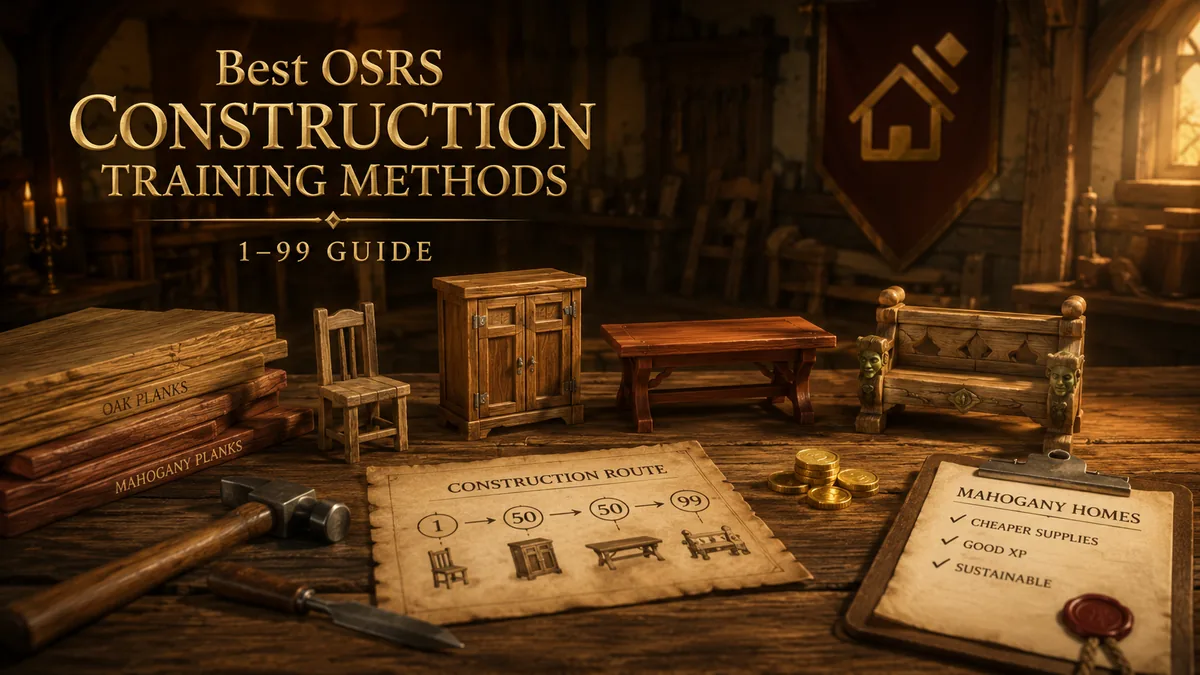
The best OSRS Construction training method depends on which resource you are shorter of: gold or hours. Gnome benches at level 77 are the fastest. Oak-based builds are the cheapest per experience among traditional methods. Mahogany Homes contracts cost the least overall but take an order of magnitude longer. This guide compares all of them and gives a practical route from 1 to 99.
Six things decide which method fits you:
- your current Construction level
- your target level
- your gold budget
- how much experience per hour you want
- how click-intensive a method you will tolerate
- which servant you have access to
Once you have picked a method, calculate the Construction XP you still need and the tool returns the builds, planks and gold between you and your target at prices you set yourself.
Every Construction training method compared
Level requirements, experience per build and materials are fixed game mechanics taken from the OSRS Wiki creation menus. Cost per experience is calculated from Grand Exchange prices checked on 25 August 2026 and will move with the market.
| Method | Level | XP per build | Materials | Relative speed | Cost per XP | Best for |
|---|---|---|---|---|---|---|
| Crude wooden chairs | 1 | 58 | 2 planks, nails | Slow | ~6.3 gp | Levels 1-9 only |
| Wooden larders | 9 | 228 | 8 planks, 8 nails | Slow | ~6.4 gp | Levels 9-19 |
| Oak chairs | 19 | 120 | 2 oak planks | Moderate | ~6.9 gp | Levels 19-22 |
| Oak dining tables | 22 | 240 | 4 oak planks | Moderate | ~6.9 gp | Levels 22-33 |
| Oak larders | 33 | 480 | 8 oak planks | Fast | ~6.9 gp | Levels 33-52 |
| Teak tables | 38 | 360 | 4 teak planks | Fast | ~8.5 gp | Situational |
| Mahogany tables | 52 | 840 | 6 mahogany planks | Very fast | ~13.0 gp | Levels 52-77 |
| Teak garden benches | 66 | 540 | 6 teak planks | Very fast | ~8.5 gp | Budget 66+ |
| Oak doors | 74 | 600 | 10 oak planks | Fast | ~6.9 gp | Cheapest late game |
| Gnome benches | 77 | 840 | 6 mahogany planks | Fastest | ~13.0 gp | Levels 77-99 |
| Mahogany Homes | 1/20/50/70 | Varies | Planks, steel bars | Slow | ~2.2-6.5 gp | Ironman, low budget |
Two figures in that table deserve a closer look, because most guides get them wrong.
A gnome bench and a mahogany table both give 840 experience for six mahogany planks. They cost exactly the same per experience. Gnome benches are faster because the superior garden has two seating hotspots, so you build twice per servant cycle rather than once. Switching at 77 buys speed, not savings.
Oak doors are the cheapest late-game build. Ten oak planks for 600 experience works out around 6.9 gp per experience against 13.0 for mahogany. They are slower, but on a tight budget the saving is roughly half.
Levels 1 to 33: get through it
The early levels exist to be passed, not optimised. From level 1, crude wooden chairs take two planks for 58 experience in a parlour. From 9, wooden larders take eight planks for 228, which cuts your click count for the same plank spend.
Oak opens at 19 with oak chairs, then oak dining tables at 22. Neither is worth camping. Level 33 is only 18,247 experience away from nothing, so the whole stretch is short.
Two practical notes. You need a hammer and a saw in your inventory to build anything, and you must set your house to building mode. Hire a servant as soon as you can: Rick at level 20 carries six items per trip, and the upgrade path continues from there.
Levels 33 to 52: oak larders
Oak larders are the first method that feels like real training. Eight oak planks for 480 experience is 60 experience per plank, one of the best ratios in the skill, and the kitchen hotspot is forgiving on clicks.
Covering 33 to 52 takes 105,413 experience, which is 220 larders and 1,760 oak planks. At prices checked on 25 August 2026 that is under a million gold for nineteen levels.
The Oak Larders guide covers the build loop, room setup and servant handling in detail.
Levels 52 to 77: mahogany tables
Level 50 unlocks the demon butler and level 52 unlocks mahogany tables, which is why most players treat 52 as the real start of Construction training. Six mahogany planks for 840 experience in the dining room, with a servant feeding you planks while you build and remove.
The stretch from 52 to 77 is 1,351,921 experience: 1,610 tables and 9,660 mahogany planks. This is where the cost of a 99 starts to bite, and where the choice between mahogany and cheaper alternatives actually matters.
The Mahogany Tables training guide walks through the loop step by step.
Levels 77 to 99: gnome benches, or the cheaper alternatives
From 77, gnome benches in the superior garden are the fastest experience in the skill. The stretch from 77 to 99 is 11,558,850 experience, 88 per cent of a full 99, which is 13,761 benches and 82,566 mahogany planks.
That last figure is the whole argument for the alternatives:
- Teak garden benches at 66 cost roughly a third less per experience than mahogany. Slower, considerably cheaper.
- Oak doors at 74 cost about half as much per experience as mahogany. Slower still, cheapest of the three. The oak dungeon doors guide covers the dungeon setup and the build cycle.
- Mahogany Homes Adept contracts cost the least of anything, at a fraction of the speed.
None of these is wrong. They price time differently. Compare the GP cost of your Construction method with your own plank prices before committing to 82,000 planks.
Mahogany Homes: the alternative track
Mahogany Homes is a Construction minigame where you take contracts from contractors in Falador, Varrock, East Ardougne and Hosidius, travel to a client’s house and repair furniture. Four contract tiers open at Construction levels 1, 20, 50 and 70, and the tier you pick decides which plank type you supply.
Contract experience is not a fixed number the way a build is. Each contract asks for a different amount of work, so treat any per-contract figure as an average rather than a mechanic. What is consistent is the direction: contracts return far more experience per plank than building furniture, and far less experience per hour.
That makes Mahogany Homes the default for ironman accounts, where every plank is a woodcutting trip rather than a purchase, and a sensible choice for any account where the bank is the constraint. The Mahogany Homes guide covers requirements, contracts and rewards.
Servants change the maths more than the method does
Every experience-per-hour figure you read for Construction quietly assumes a servant fetching planks. Without one you walk to the bank yourself and the rate collapses regardless of what you are building.
Five servants are available, hired from the Servants’ Guild in Ardougne:
| Servant | Construction level | Fee | Capacity | Can use sawmill |
|---|---|---|---|---|
| Rick | 20 | 500 coins | 6 items | No |
| Maid | 25 | 1,000 coins | 10 items | No |
| Cook | 30 | 3,000 coins | 16 items | Yes |
| Butler | 40 | 5,000 coins | 20 items | Yes |
| Demon butler | 50 | 10,000 coins | 26 items | Yes |
Fees are charged every eight trips, and the wage is trivial against the plank bill at any serious rate. The full servant comparison covers trip times and when each upgrade is worth taking.
Choosing your route
Three routes cover almost every account.
The speed route. Oak larders to 52, mahogany tables to 77, gnome benches to 99. The shortest time to a cape and the largest bill.
The balanced route. Oak larders to 52, mahogany tables to 66, teak garden benches to 99. A modest drop in rate for roughly a third off the mahogany cost.
The budget route. Mahogany Homes from 20 onwards, moving up a contract tier whenever you unlock one. The cheapest by a wide margin and by far the longest.
None of these is a recommendation without your numbers attached. Put your current level and target into the Construction calculator, set plank prices to what the Grand Exchange shows today, and read the total gold and total hours for each option side by side.
Where the numbers in this guide come from
Level requirements, experience per build and material counts are read from the OSRS Wiki creation menus for the chair, larder, table and door hotspots, and from the individual item pages for the garden benches. Those values are fixed game mechanics and only change if Jagex changes them.
Cost per experience is calculated as material cost divided by experience gained, using Grand Exchange insta-buy prices checked on 25 August 2026. Those figures move. The GE price tracker shows current prices, and the calculator lets you overwrite every default.
Experience per hour is deliberately expressed as relative speed in this guide rather than a hard number. Real rates depend on your click accuracy, your house layout, your servant, latency and how often you bank. Treat any published rate as a ceiling you approach with practice.