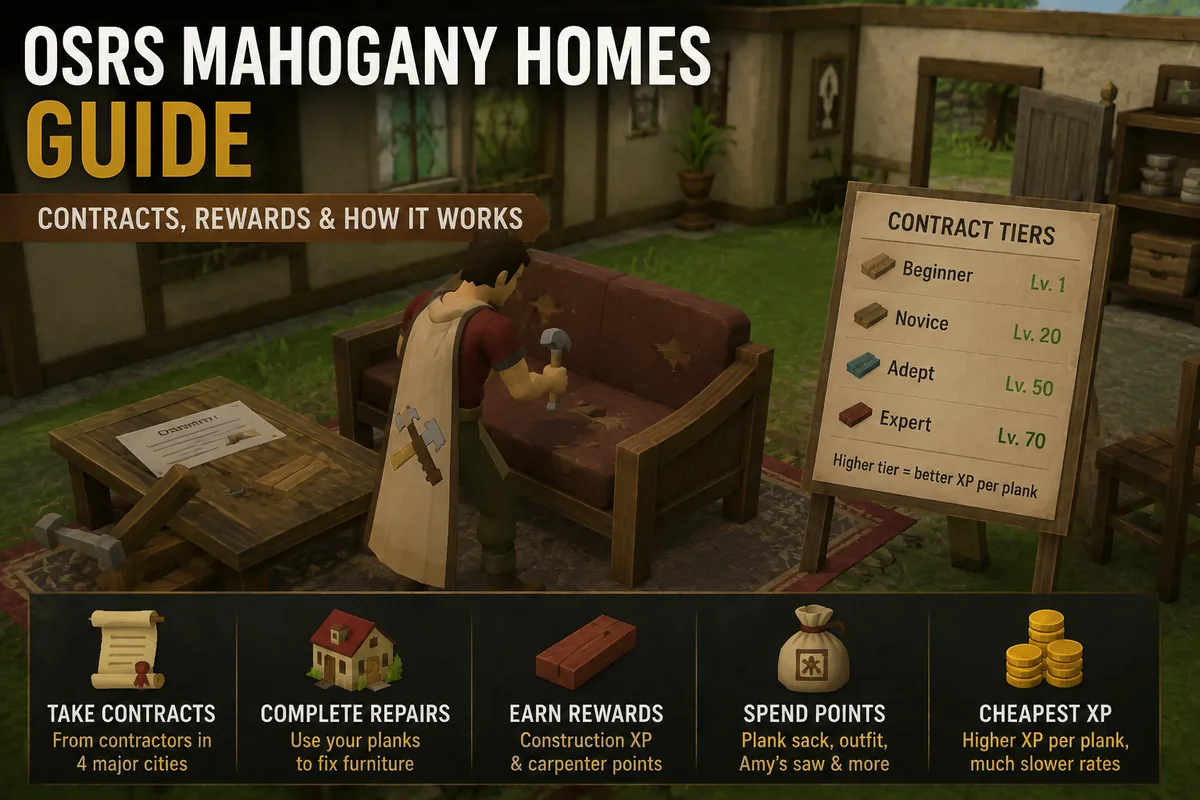
Mahogany Homes is an OSRS Construction minigame where you take contracts from contractors in Falador, Varrock, East Ardougne and Hosidius, travel to a client’s home and repair or replace furniture using your own planks. It is the cheapest way to train Construction per experience, and by a wide margin the slowest.
This guide covers how contracts work, what each tier requires, what the rewards are worth, and when contract training beats building furniture in your own house.
How a contract works
The loop is simple and repeats:
- Speak to a contractor in Falador, Varrock, East Ardougne or Hosidius.
- Take a contract at the tier you want. The client’s home is assigned at random.
- Travel to that home.
- Repair or replace the furniture the contract specifies, using planks from your inventory.
- Return to a contractor to hand the contract in.
- Collect Construction experience and carpenter points.
Two things separate this from ordinary Construction training. You are working in someone else’s house, so no player-owned house, room or servant is involved at all. And the contract completion itself pays additional experience on top of what the individual repairs give.
Contract tiers and requirements
| Tier | Construction level | Plank type | Steel bar |
|---|---|---|---|
| Beginner | 1 | Planks | Occasionally |
| Novice | 20 | Oak planks | Occasionally |
| Adept | 50 | Teak planks | Occasionally |
| Expert | 70 | Mahogany planks | Occasionally |
You may take any tier you meet the level requirement for, and the tier you choose decides which plank type the work consumes. That single fact drives the entire cost comparison later in this guide.
Contract experience is not a fixed number. Each contract asks for a different amount of repair work, so the experience and plank count vary between contracts of the same tier. Any per-contract figure you see published, here or elsewhere, is an average across many contracts rather than a mechanic you can read off a menu.
Carpenter points and rewards
Completing contracts pays carpenter points alongside experience, spendable at the Mahogany Homes Reward Shop. The rewards worth planning around are:
The plank sack. Holds 28 planks on top of your inventory. On Adept and Expert contracts this roughly halves your banking, which is most of the difference between the low and high end of any published rate for the minigame. Buy it first.
Carpenter’s outfit. A five-piece set giving a combined Construction experience bonus when worn as a full set. The bonus applies to every method in the skill, not just contracts, so it is worth completing even if you plan to switch to furniture later.
Amy’s saw. A saw and hammer in one item, freeing an inventory slot.
Because the outfit bonus carries over to furniture training, a common pattern is to run contracts long enough to finish the set and buy the plank sack, then decide whether to continue or switch.
Cost per experience: why contracts win
Contracts return substantially more experience per plank than building furniture. Furniture is a fixed exchange. A teak garden bench always gives 90 experience per teak plank, an oak larder always 60 per oak plank. Contract repairs return more, which is what makes the minigame cheap.
Approximate cost per experience at Grand Exchange prices checked on 25 August 2026:
| Method | Plank type | Approximate cost per XP |
|---|---|---|
| Mahogany Homes: Novice | Oak | ~2.2 gp |
| Mahogany Homes: Beginner | Regular | ~2.5 gp |
| Mahogany Homes: Adept | Teak | ~2.8 gp |
| Mahogany Homes: Expert | Mahogany | ~6.5 gp |
| Oak larders | Oak | 6.9 gp |
| Teak garden benches | Teak | 8.5 gp |
| Mahogany tables / gnome benches | Mahogany | 13.0 gp |
The counter-intuitive result is that Expert is the most expensive contract tier, because it runs on mahogany planks. If your goal is the lowest possible bill rather than the fastest contract, a lower tier on cheaper planks costs less per experience.
The GP per XP ranking shows the arithmetic behind every row.
Speed: the honest trade
Contracts involve travel, dialogue and repair animations rather than a two-click build-and-remove loop. That makes them dramatically slower per hour than furniture training, and no plank sack or teleport setup closes that gap.
Published experience-per-hour figures for Mahogany Homes vary widely with travel method, teleport availability and whether you have the plank sack. Treat any single number with suspicion; what is reliable is the direction. Contracts trade an order of magnitude of speed for roughly half to a quarter of the cost per experience.
That trade is the whole decision.
Who Mahogany Homes suits
Ironman accounts. There is no realistic alternative. Every plank on an ironman is a woodcutting trip and a sawmill run, so getting more experience out of each one is worth far more than clicks per hour.
Accounts with a shallow bank. A 99 through furniture is a serious gold commitment. Contracts bring it within reach of accounts that could not otherwise attempt the skill.
Players who want less intensity. Contracts do not punish a slow reaction the way a butler loop does. They are not AFK, but they are considerably more forgiving.
Who should build furniture instead
Accounts optimising for hours. If you have the gold, furniture finishes in a fraction of the time. The Mahogany Tables guide and the Oak Larders guide cover the two most common builds.
Players chasing a specific level fast. Contract training measured in weeks against furniture measured in hours is not a close call when a deadline exists.
Getting started
Take Beginner contracts from level 1 if you are starting from scratch, or jump straight to the highest tier you qualify for. Bring planks matching your tier, a few steel bars, a hammer and a saw.
Set up teleports to the four contract cities before you settle in, Falador, Varrock, East Ardougne and Hosidius, because travel is where the time goes.
Comparing the two tracks for your own goal
The right comparison is not method against method in the abstract. It is total gold and total hours for your current level and your target.
Open the Construction calculator, enter your current experience, set your target, and switch between a Mahogany Homes tier and a furniture method. The gold column and the hours column move in opposite directions, and where you land between them is a personal decision rather than a technical one.
For a broader view of every route, see the 1-99 Construction training methods guide.
Sources for this Mahogany Homes guide
Contract tiers, level requirements, materials and reward mechanics come from the OSRS Wiki Mahogany Homes page and are fixed game mechanics. Cost-per-experience figures use Grand Exchange insta-buy prices checked on 25 August 2026 and will move with the market; the GE price tracker has current values. Per-contract experience is stated as an average throughout because contract size genuinely varies.