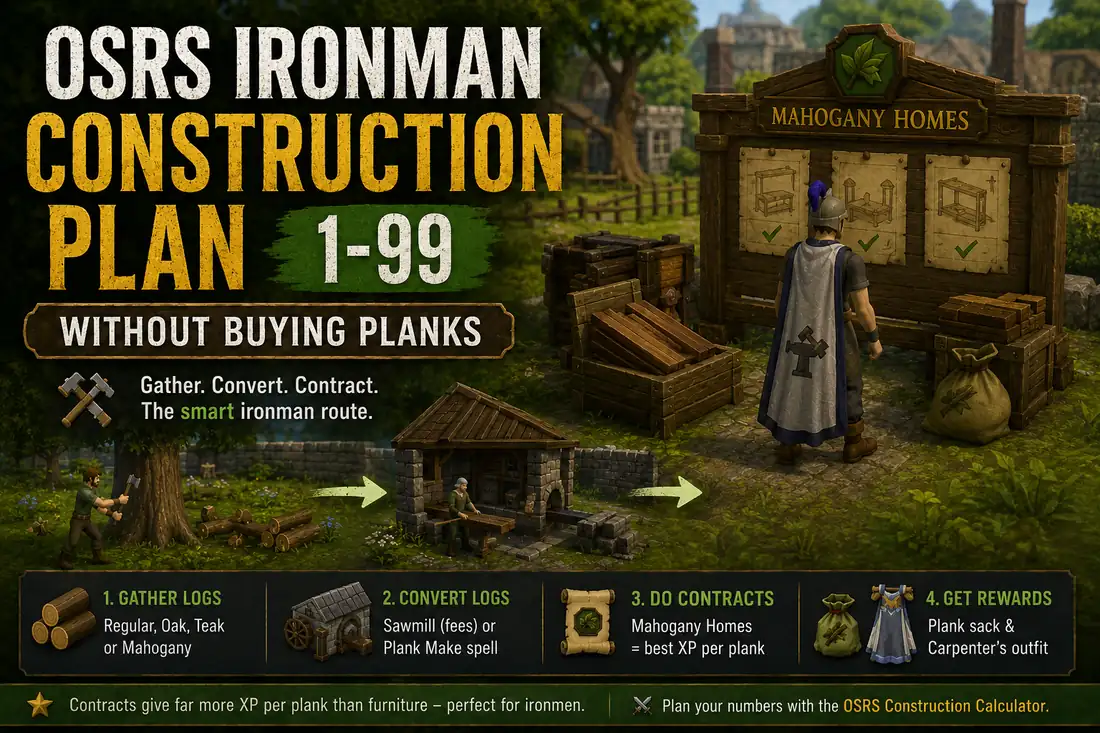
On an ironman, Construction is a logistics problem rather than a gold problem. You cannot buy 80,000 mahogany planks, so the entire speed route is unavailable and the question becomes how much experience you can extract from each log you cut.
That single change flips the usual advice. Mahogany Homes contracts, which most main accounts treat as the slow option, become the correct choice, because they return far more experience per plank than any furniture build.
Why the normal route does not work
Furniture is a fixed exchange rate between planks and experience:
| Plank | Experience per plank via furniture |
|---|---|
| Regular | ~29 |
| Oak | 60 |
| Teak | 90 |
| Mahogany | 140 |
A 99 through gnome benches needs 82,566 mahogany planks. On a main that is a purchase. On an ironman it is 82,566 mahogany logs cut by hand, hauled to a sawmill and converted.
Mahogany Homes contracts return more experience per plank than any of those rows. That does not make them fast, they are considerably slower per hour, but on an account where planks are the bottleneck, experience per plank is the only ratio worth optimising.
The route
| Levels | Contract tier | Plank type | Why |
|---|---|---|---|
| 1-20 | Beginner | Regular planks | Cheap logs, gets the outfit started |
| 20-50 | Novice | Oak planks | Oaks are everywhere and convert for 250 coins |
| 50-70 | Adept | Teak planks | Dense teak spots, 500-coin conversion |
| 70-99 | Expert | Mahogany planks | Highest experience per contract |
Each tier is gated by Construction level: Beginner at 1, Novice at 20, Adept at 50, Expert at 70. You may take any tier you qualify for, and the tier decides which plank you must supply.
There is a real argument for staying on Adept longer than the level gate requires. Teak logs are faster to gather than mahogany and the sawmill fee is a third as much, so an account short on gathering time often gets more levels per hour of total effort from Adept contracts than from Expert.
Gathering, in batches
The mistake ironmen make is alternating: chop a bit, convert a bit, contract a bit. Context switching costs more than either activity.
Batch instead:
- One session cutting. Fill your bank with logs of the tier you need.
- One session converting. Run logs to the sawmill in inventory-sized batches, or cast Plank Make if you have it.
- One session on contracts. Burn the plank pile without stopping to gather.
Teak is the tier that rewards this most. Dense teak spots on Ape Atoll and Fossil Island make a cutting session productive, and the 500-coin conversion is affordable from ordinary ironman income.
Converting logs: sawmill or Plank Make
Two routes exist. The sawmill operator charges a fixed fee per log:
| Plank | Sawmill fee | Plank Make fee |
|---|---|---|
| Plank | 100 gp | 70 gp |
| Oak plank | 250 gp | 175 gp |
| Teak plank | 500 gp | 350 gp |
| Mahogany plank | 1,500 gp | 1,050 gp |
Plank Make is a Lunar spell requiring level 86 Magic and completion of Dream Mentor. It converts one log at 70 per cent of the sawmill fee, costs 2 astral, 1 nature and 15 earth runes per cast, and gives 90 Magic experience.
On raw gold, the sawmill usually wins: the rune cost per cast was 456 gp on 25 August 2026, more than the fee saving on every tier except mahogany, where the two were within a few gold of each other.
On an ironman the calculation shifts, because runes you crafted yourself are not the same as runes you bought, and casting in place saves a trip per inventory. If you already have the requirements, Plank Make is worth using. Training to 86 Magic solely to unlock it is not.
The Plank Make versus buying comparison works the full arithmetic through.
Rewards worth prioritising
Contracts pay carpenter points alongside experience, and two rewards change the grind materially.
The plank sack holds 28 planks on top of your inventory. On Adept and Expert contracts it roughly halves your banking, which is the largest single rate improvement available to an ironman. Buy it first, before anything else.
Carpenter’s outfit is a five-piece set giving a Construction experience bonus when worn complete. Because the bonus applies to every method in the skill, and because you will be running thousands of contracts regardless, finishing the set early compounds across the whole account.
Servants: mostly irrelevant here
Contracts happen in NPC houses, so no servant is involved. That removes an entire cost and setup step compared with the main-account route.
The exception is the sawmill. The cook, butler and demon butler can be sent to convert logs on your behalf, which is worth reaching Construction level 30 for if you are converting in volume. Rick and the maid cannot. See the servant comparison for the full table.
Should an ironman ever build furniture?
Occasionally, yes.
Oak larders at 33 are the cheapest furniture build in plank terms at 60 experience per oak plank, and oak logs are trivial to gather. If your contract travel is frustrating you, a session of larders is a reasonable change of pace.
Mounted mythical capes are the interesting case. Built in the quest hall from level 47 with Dragon Slayer II completed, they return 123 experience per teak plank against the 90 that ordinary teak furniture gives. That is close to contract efficiency without the travel, and worth pricing if you have the quest done. The mounted mythical cape guide covers the loop in full.
For anything above those, furniture on an ironman means gathering several times the logs for the same levels. The GP per XP ranking shows the gap.
Picking a target
Very few ironmen need 99 Construction. The levels that change how the account plays are lower:
- 72, portal nexus, the travel hub
- 75, gilded altar for Prayer, and the spirit tree
- 80, achievement gallery
- 81 / 86 / 91. The three jewellery box tiers
An ironman who reaches 75 has the two builds that matter most day to day. The 83 vs 91 vs 99 comparison covers the decision in detail.
Planning your own numbers
Contract experience varies between contracts, so a single per-contract figure is an average rather than a mechanic. What is exact is the experience you need.
Open the Construction calculator, paste your current experience and set the target that actually changes your account. Switch the plank source to Sawmill and enter your own log values, on an ironman the “price” of a log is your gathering time, so set it to zero and read the plank count instead of the gold. That number, not the gold column, is your real project size.
For the wider view, see the 1-99 Construction training methods guide and the Mahogany Homes guide.
Sources for this ironman plan guide
Contract tiers, level requirements and reward mechanics come from the OSRS Wiki Mahogany Homes page. Sawmill fees and Plank Make requirements, rune cost and conversion rate come from the wiki and are fixed mechanics. Experience per plank through furniture is calculated from the creation-menu values. The 456 gp rune cost uses Grand Exchange prices checked on 25 August 2026 and will move.